EVA ROBARTS
A Trip To The Coast
_
Opening:
Friday, Sept 4, 2026 , 6-9 pm
7.30pm: Eva Robarts, Poetry Reading
_
offical participant of DC Open 2026:
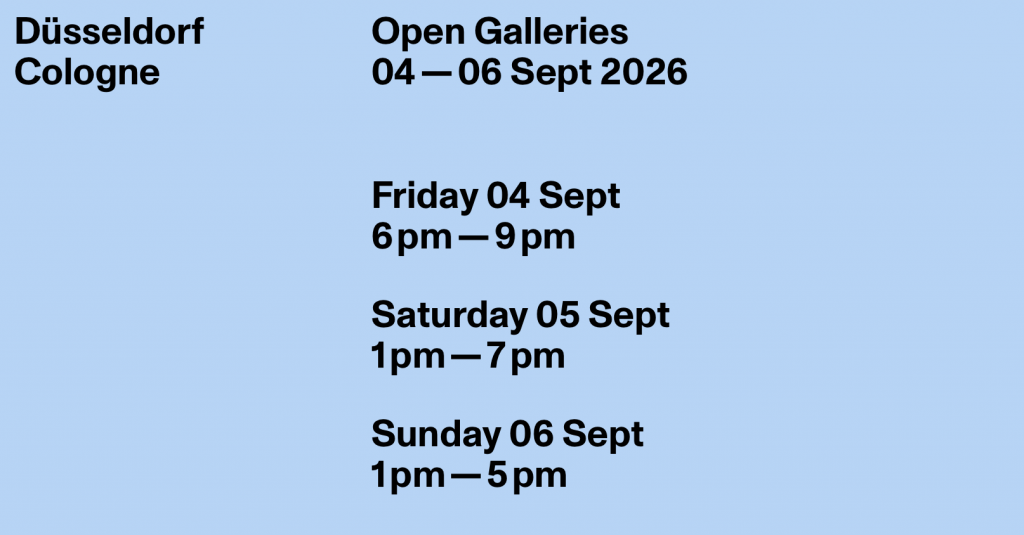
exhibition period: 4 Sept – 14 Oct 2026
_
_
Pressemitteilung Deutsch
Eva Robarts
A Trip To The Coast
Dritte Einzelausstellung der Künstlerin in der Galerie Berthold Pott, Köln, eröffnet im Rahmen der DC Open am 4. September 2026.
Mit A Trip To The Coast präsentiert die Galerie Berthold Pott im Rahmen der diesjährigen DC Open die dritte Einzelausstellung der amerikanischen Künstlerin Eva Robarts (*1982, Miami; lebt und arbeitet in Brooklyn, New York). Die Ausstellung vereint neue Arbeiten aus der Werkreihe Weavings mit Malereien, Zeichnungen sowie einer erstmals gezeigten Videoarbeit und gibt einen konzentrierten Einblick in eine skulpturale Praxis, die Materialität, Erinnerung und Transformation in ein vielschichtiges Spannungsverhältnis setzt.
Der Ausgangspunkt von Eva Robarts’ Arbeiten liegt im Sammeln urbaner Fundstücke. Auf ihren Streifzügen durch New York, Miami und andere Städte sammelt sie Objekte, die bereits von der Gesellschaft aussortiert wurden: Fahrräder, Zaunelemente, Bälle, Besenstiele oder Materialien aus Haushaltsauflösungen und Renovierungen. Es sind Relikte des Alltags, deren Gebrauchswert erschöpft scheint und die im öffentlichen Raum als Überreste einer permanenten materiellen Zirkulation erscheinen.
Robarts versteht diese Objekte jedoch nicht als Readymades im klassischen Sinne, sondern als Material mit eigener Geschichte und spezifischer physischer Präsenz. Im Atelier unterzieht sie die Fundstücke einem offenen Prozess des Zerlegens, Schneidens, Verspannens, Verwebens und Neuarrangierens. Aus diesem dialogischen Umgang mit dem Material entstehen mehrschichtige skulpturale Gefüge, in denen Konstruktion und Improvisation, Ordnung und Unordnung, Fragilität und Widerständigkeit gleichermaßen wirksam bleiben.
Im Zentrum der Ausstellung stehen neue Arbeiten der Werkreihe Weavings. Aus ausrangierten Besenstielen entwickelt Robarts reliefartige Wandarbeiten, deren verflochtene Struktur gleichermaßen an textile Gewebe, architektonische Raster und konstruktive Zeichnungen erinnert. Das Weben wird hier nicht als textile Technik verstanden, sondern als bildhauerisches Verfahren, das Volumen, Oberfläche und Raum miteinander verschränkt.
Die überwiegend aus Metall und Kunststoff bestehenden Besenstiele tragen die Spuren ihrer früheren Verwendung und Gebrauch sichtbar in sich. Verformungen, Rost, abgeplatzte Lackierungen und Materialermüdungen werden nicht kaschiert, sondern als integrale Bestandteile der skulpturalen Komposition lesbar. Die physische Widerständigkeit des Materials bleibt jederzeit präsent; sie wird nicht überwunden, sondern produktiv gemacht. Gerade aus dieser Spannung zwischen formaler Ordnung und materieller Eigenwilligkeit beziehen die Arbeiten ihre besondere Präsenz.
In den Weavings verschränken sich lineare Rhythmen, Verdichtungen und Öffnungen zu räumlichen Feldern, die zwischen Relief, Skulptur und Zeichnung oszillieren. Die Werke entfalten eine eigentümliche Balance aus konstruktiver Strenge und improvisatorischer Offenheit und laden den Blick dazu ein, den eingeschriebenen Bewegungen des Materials zu folgen.
Robarts’ Arbeiten reflektieren grundlegende Fragen nach Wert, Nutzung und Zirkulation von Dingen innerhalb einer von Konsum geprägten Gesellschaft. Indem sie ausrangierte Materialien aus ihrem ursprünglichen Funktionszusammenhang löst und in neue ästhetische Konstellationen überführt, verschiebt sie deren Bedeutung. Das scheinbar Wertlose wird zum Träger materieller Erinnerung; Gebrauchsspuren werden zu Bildträgern von Zeit, Erfahrung und Transformation. Ihre Skulpturen eröffnen damit einen poetischen wie zugleich präzisen Blick auf die Biografien von Dingen und auf die Prozesse, durch die Bedeutung kontinuierlich neu erzeugt wird.
Ergänzt werden die Weavings durch aktuelle Malereien und Zeichnungen, in denen sich Fragen nach Linie, Struktur und räumlicher Organisation auf der Fläche fortsetzen. Eine erstmals präsentierte Videoarbeit erweitert die Ausstellung um eine zeitbasierte Perspektive und macht den performativen Charakter von Robarts’ Arbeitsprozess sichtbar.
Eva Robarts (*1982, Miami) lebt und arbeitet in Brooklyn, New York. Sie studierte Bildhauerei am Pratt Institute in Brooklyn. Ihre Arbeiten wurden international in Einzel- und Gruppenausstellungen präsentiert, darunter in der Kunsthalle Bremerhaven, dem Brooklyn Sculpture Park, Nicola Vassell (New York), The Hole (New York), Primary Projects (Miami), der Post-Morrow Foundation (Brookhaven, NY), Keteleer Gallery (Antwerpen), der Frédéric de Goldschmidt Collection (Brüssel) sowie mehrfach in der Galerie Berthold Pott, Köln.
Eröffnung: 4. September 2026, 18 Uhr (DC Open)
Ausstellung: 4. September – 14. Oktober 2026
Berthold Pott
Widdersdorfer Straße 185
50825 Köln
+49 151 24034477
berthold@bertholdpott.com
www.bertholdpott.com
_
Press Release
Eva Robarts
A Trip To The Coast
Berthold Pott Gallery is pleased to present A Trip To The Coast, the third solo exhibition by American artist Eva Robarts, opening on September 4, 2026, as part of DC Open.
Bringing together new works from Robarts’ ongoing Weavings series alongside paintings, drawings, and a video work presented publicly for the first time, A Trip To The Coast offers an insight into a sculptural practice that explores the intersections of materiality, memory, and transformation.
Robarts begins with the city itself. Walking through New York, Miami, and other urban environments, she collects objects that have been abandoned or discarded—bicycles, sections of fencing, balls, broom handles, and materials salvaged from house clearances and renovation sites. These remnants of everyday life, stripped of their original function, bear witness to the continuous circulation of materials through the urban landscape.
Rather than treating these objects as readymades, Robarts approaches them as materials carrying their own histories and physical agency. In the studio, they undergo an open-ended process of dismantling, cutting, tensioning, weaving, and reassembly. The resulting works emerge through an ongoing dialogue with the material itself, balancing structure and improvisation, order and contingency, fragility and resilience.
At the heart of the exhibition are new works from the Weavings series. Constructed from discarded broom handles, these relief-like wall pieces recall woven textiles, architectural grids, and linear drawings while remaining firmly rooted in sculpture. Here, weaving is understood not as a textile technique but as a sculptural method through which surface, volume, and space become inseparable.
The broom handles—primarily made of metal and plastic—retain the visible traces of their previous lives. Bent forms, rust, chipped paint, and signs of wear are neither repaired nor concealed but become essential components of each composition. Rather than overcoming the resistance of the material, Robarts works with it, allowing its inherent character to shape the final form. It is within this dynamic between formal precision and material unpredictability that the works acquire their distinctive presence.
Across the Weavings, linear rhythms, dense intersections, and open passages unfold into spatial fields that oscillate between drawing, relief, and sculpture. Their visual language combines structural clarity with an improvisational sensibility, inviting viewers to follow the trajectories and tensions embedded within the material itself.
Underlying Robarts’ practice is a sustained reflection on the value, use, and circulation of objects within a culture shaped by consumption. By removing discarded materials from their original contexts and reconfiguring them into new aesthetic relationships, she shifts the terms through which they are understood. What once appeared valueless becomes a repository of material memory, while traces of use are transformed into records of time, experience, and change. Her sculptures offer both a poetic and incisive meditation on the lives of objects and on the processes through which meaning is continually produced.
The exhibition is complemented by recent paintings and drawings, in which concerns with line, structure, and spatial organization continue across the picture plane. A newly presented video work further expands the exhibition, revealing the performative dimension of Robarts’ studio process and the physical negotiations that underpin her sculptural practice.
Eva Robarts (b. 1982, Miami) lives and works in Brooklyn, New York. She received her BFA in Sculpture from Pratt Institute, Brooklyn. Her work has been exhibited internationally in solo and group exhibitions, including at Kunsthalle Bremerhaven; Brooklyn Sculpture Park; Nicola Vassell, New York; The Hole, New York; Primary Projects, Miami; Post-Morrow Foundation, Brookhaven, New York; Keteleer Gallery, Antwerp; the Frédéric de Goldschmidt Collection, Brussels; and Galerie Berthold Pott, Cologne.
Opening
September 4, 2026, 6 pm (DC Open)
Exhibition
September 4 – October 14, 2026
Galerie Berthold Pott
Widdersdorfer Straße 185
50825 Cologne, Germany
+49 151 24034477
berthold@bertholdpott.com
www.bertholdpott.com
_
Exhibition Text:
–
Poem by Eva Robarts:
A Trip to the Coast
This city wants me to leave but I don’t give in.
Prices rise
Like ocean tides.
I fantasize about a trip to the Coast.
But I know it’s never coming.
My music is the white noise that windows can’t block.
Sparks that rain from train trestles
Sirens that blare behind buildings
Poorly planned intersections lit by crosswalks facing some other direction.
I take my chances and cross.
Upon impact—I see things clear.
Answers that soften the blow as the body goes horizontal.
I pick up the bike and lick my wounds.
Taco’d tires and a twisted seat point toward the only place left to go.
That place I’ve been avoiding.
That place inside that makes you soft, makes you true, makes you real to me.
Because it’s 1am and it’s THE ONLY FUCKEN PLACE OPEN RIGHT NOW!
But look—it’s cool—I know this spot, we can bring it there.
Leave it on the basement landing and she’ll get it tomorrow.
I take these bikes.
Every. Single. One.
The drivetrain, surgically removed with four cuts above the chain and seat stay.
Toss the training wheels.
Derailers, foot pegs, fenders and kickstands stay negotiable.
V
(pointing at sculpture)
V V V V V V V V V
(up in scale)
V V V V V V V V V
(down in scale)
V
(audience participation)
V is for Vernon Ave where my grandparents lived.
V is for I’m Visiting, Brooklyn just borrowed me.
V is for the tattoo I wish I’d never gotten.
V is for triangles turned upside down.
Pyramids with no past.
Discarded on desert sand.
Stuffed composition books that can’t close.
Vitruvian men on HRT.
V is the view from the JMZ.
I like the feeling of two V’s nested together.
A cold cuddle.
Scuffed-up Huffy’s bolted together.
Bikes that bless with grease stains.
V is for vacation.
TSA flagged all my shit once they saw I had tits—
„Sir… please step this way.“
V is for all the things you’ll never be.
All the things you’ll never do.
V is for verdant forests, votive offerings and Venus in retrograde.
V is for I voted for corporate hacks just to keep my Medicaid.
On my walk home
I crouched at the curb
and washed a broomstick
in hydrant water
running downhill.
I can only imagine ~
V is for Venice as it sinks away.
V fits between E and A.
